
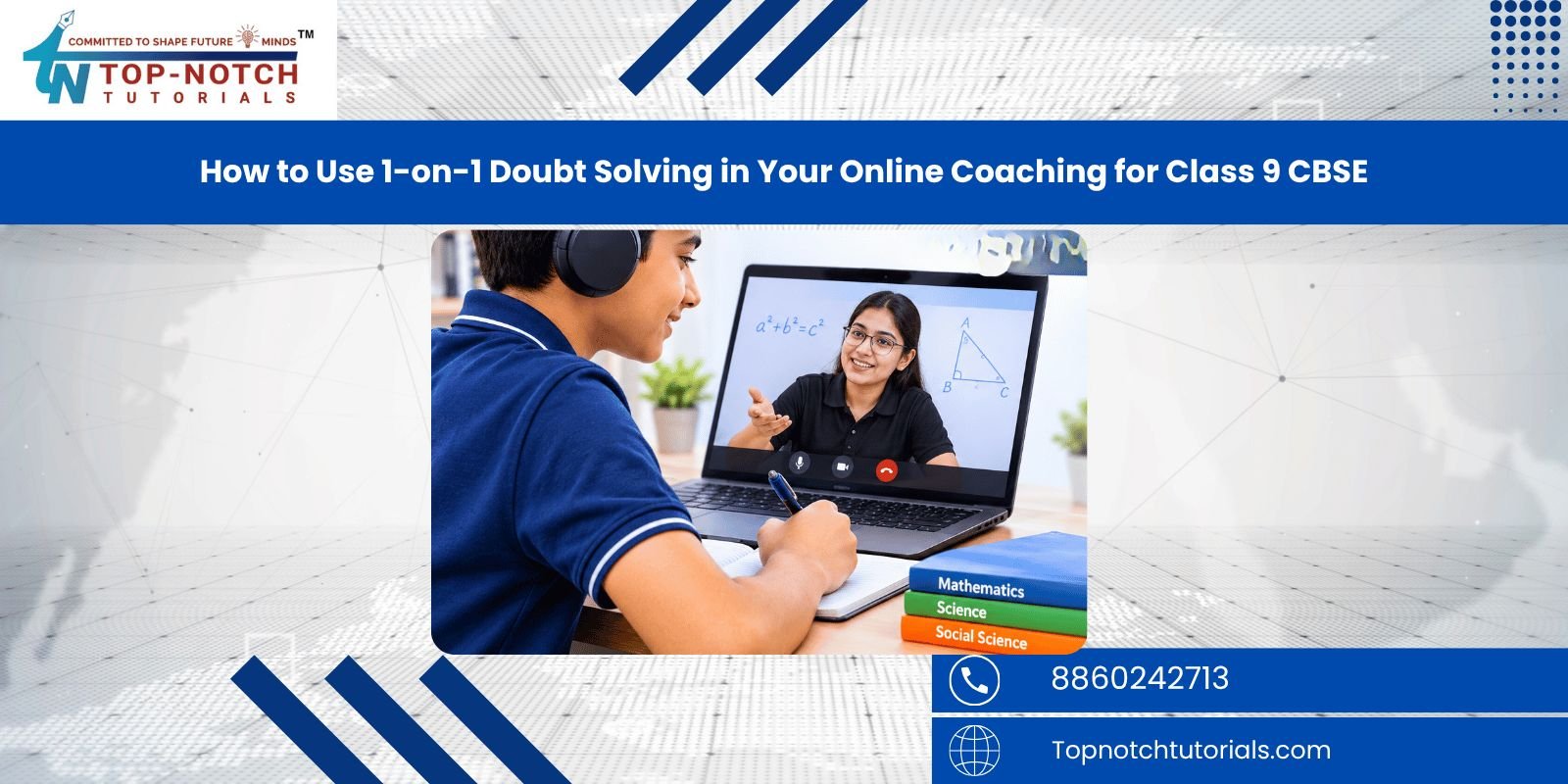
Class 9 is important in a student’s educational career. Subjects become more complex, ideas become more complicated, and students are required to understand concepts instead of just learning answers by heart. Maths and science, in particular, need steady practice.
That is why online coaching for Class 9 CBSE works best when it includes one-on-one doubt support. You get a chance to ask what you could not ask in class, see where you went wrong and move ahead with a clear head.
But just booking a session is not enough. How you use that time decides how much you gain.
Why Is 1-on-1 Doubt Solving Important in Class 9?
Every child learns at a different speed. One student does well through algebra but gets stuck in geometry. Another loves science diagrams but finds chemical reactions confusing.
In a live group class, the teacher cannot stop for each person. A private session fixes that, because the whole time it is about your questions.
Here is what you gain:
- Personal attention: no one is watching
- Clearer concepts: simpler examples
- Quick feedback: mistakes spotted instantly
- More confidence: less fear of difficult chapters
- Better habits: asking becomes normal
Take linear equations. If a student keeps getting them wrong, the teacher can check the cause. It may be a calculation slip, a sign error, or a gap in understanding the equation itself.
Once the real cause is found, it gets fixed. The student does not have to memorise yet another method.
How to Make the Most of Online Coaching for Class 9 CBSE Doubt Sessions
A doubt session is like a doctor’s visit. The more clearly you describe the problem, the faster the treatment works. Here is how to do that.
1. Write Down Doubts During Class
Do not wait for exam time. The moment something confuses you, note it down.
It is important to have one notebook for every subject where you will write:
- Topic & chapter
- Question that you could not answer
- Step at which you got stuck
- What you tried already
For example, you know a formula for calculating speed in physics. However, you may be having trouble translating kilometres into meters. You should write down this exact problem for your next meetings.
2. Try Before You Ask
Asking for help is good. Trying first is even better.
Spend ten minutes on the question yourself. Even if you do not reach the answer, you will know which steps you understood. That helps the teacher see your gap clearly.
In a triangle problem, for instance, first write down the given angles and the properties you think apply. Then ask.
3. Ask Specific Questions
“I don’t understand this chapter” is too broad. Try these instead:
- Why this formula?
- Where did the negative sign come from?
- Is there another method?
- How do I pick the theorem?
Sharp questions get sharp answers, and you save time.
4. Solve a Similar Question
Following a solution on screen feels easy. Doing it alone is the real test.
Once your doubt is cleared, try one more question on the same concept. If you make the same mistake again, tell your teacher.
This habit makes top notch tutorials doubt sessions more useful, because you practise what you learn instead of just listening.
5. Revise Cleared Doubts
Do not shut the notebook after the explanation. At the end of each week, go through old doubts and solve them again without looking at the answers.
This matters a lot in maths and science, where one chapter often leads into the next.
How to Clear Doubts in Online Classes More Effectively
Many students stay quiet in online lessons. They think the doubt is too silly, or they do not want to interrupt. In reality, teachers are happy when students ask.
Here is how to clear doubts in online classes without feeling awkward:
- Use the tools: if the platform has chat, voice or screen share, use them to explain your problem.
- Show your steps: share how you attempted the question, not just the question. Mistakes show up quickly.
- Ask again: if the first explanation does not click, ask for another example or a slower walkthrough.
- Be ready: keep your textbook, notebook and worksheets open before the session starts.
A little preparation makes the session calmer and far more useful.
Self Study vs Online Coaching: Why Both Matter
Parents and students often debate self study vs online coaching. Honestly, you do not have to pick one. They work best together.
Self-study builds discipline and independent thinking. Online coaching adds structure, guidance and a teacher who can untangle tough concepts.
| Self Study | Online Coaching |
| Builds independent habits | Gives expert guidance |
| Lets you set your pace | Offers structured lessons |
| Shows your weak spots | Gives feedback and doubt support |
| Needs self-discipline | Provides a fixed schedule |
Imagine a student who studies Maths alone for 45 minutes and then takes two stubborn questions to a teacher. That student will usually understand the chapter better than someone who only watches recorded lessons.
CBSE Class 9 Preparation Strategy 2026: Using Doubt Sessions Wisely
A simple routine keeps schoolwork, coaching and revision from stacking up. Here is a plan that works for many students:
- Follow the syllabus. Stay in step with what school is teaching.
- Attend lessons. Understand the concept before attempting harder questions.
- Practise alone. Solve textbook exercises, worksheets and sample papers.
- Book doubt sessions. Take only the questions you could not crack yourself.
- Revise weekly. Go over formulas, definitions, diagrams and old doubts.
- Take chapter tests. They show your weak areas early.
Do not ignore English, social science and your second language. Many students pour all their time into maths and science and then lose easy marks elsewhere.
Frequently Asked Questions
How does 1-on-1 doubt solving help Class 9 CBSE students?
It gives each student a teacher’s full attention. They can talk about hard issues, they can understand when they are wrong and get explanations at their level. It builds knowledge and confidence over time.
How to remove doubts in online classes without nervousness?
Write down your questions first and say what you have already tried. If you don’t understand a step, have the teacher go over it with you again. It’s part of the learning process to ask questions.
Are individual doubt sessions useful for Maths and Science?
Yes. Both subjects mix concepts, calculations and problem-solving. In a private session, the teacher can go through formulas, numericals and diagrams at a comfortable speed.
Is studying alone enough to prepare for the CBSE Class 9 exams?
Self-study is great, but some concepts need a tutor to help. Both are needed for organised preparation.
How often should students attend doubt-solving sessions?
There is no fixed number. Clear doubts as they come up, and use a weekly session to revisit difficult topics and check progress.
Conclusion
One-on-one doubt solving can change how a student feels about Class 9. You can ask freely, fix mistakes early and build strong concepts.
Still, the effort has to come from the student too. Regular practice, weekly revision and some independent study make Online Coaching for Class 9 CBSE far more effective.
Topnotch Tutorials help students receive guidance and support to deal with difficult topics with more confidence. Check the learning programmes at Topnotchtutorials.